
Copper Wire Manufacturer in Delhi: 6 Checks Before You Order
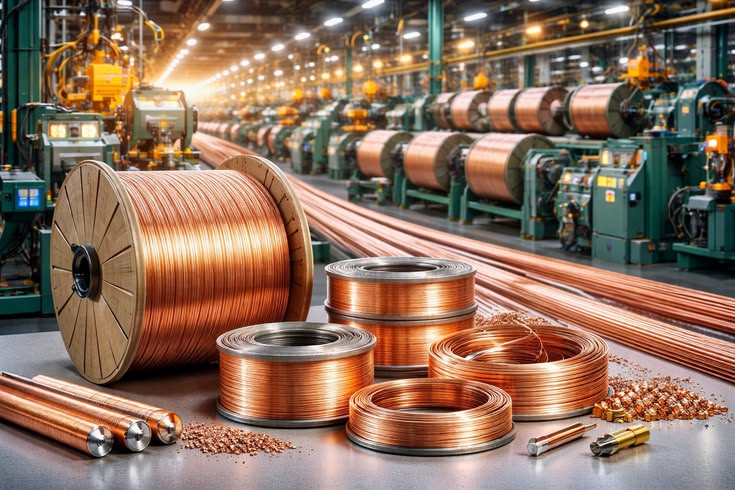
A good copper wire manufacturer in Delhi is one that makes the exact type of wire you need, names the copper grade and standard without hesitating, shares a test certificate for your batch, and can show you where the wire is actually made. That sounds obvious. But "copper wire" covers at least four very different products, and search results mix them all together, so it's easy to end up calling the wrong supplier.
Which Kind of Copper Wire Do You Actually Need?
Search for a copper wire manufacturer, and you'll see bare wire, house wiring, fuse wire and coil wire listed side by side. They're made on different machines, often in different factories.
|
Type |
What it is |
Where it's used |
|
Bare / annealed copper wire |
Soft, uncoated copper |
Earthing, braiding, general conductors |
|
Tinned copper wire |
Copper with a thin tin coating |
Fuse wire, connections that face corrosion |
|
PVC-insulated copper wire |
Copper inside thick plastic |
House wiring, panels, appliances |
|
Enamelled winding wire |
Copper with a very thin, heat-resistant coat |
Motors, transformers, coils |
A company that's excellent at one of these isn't automatically good at another. Wiring a building calls for a cable maker with ISI-marked products. Winding a motor calls for a winding wire specialist. Decide which one you are before you start comparing quotes.
How Copper Wire Is Actually Made
It starts with high-purity electrolytic copper, usually cast into an 8 mm rod. That rod is pulled through a series of dies, a step called wire drawing, until it reaches the thickness you ordered. Drawing makes copper harder and more brittle, so the wire is then annealed, which means heated to soften it again. Enamelled wire gets one more stage: it passes through liquid enamel and a hot oven several times, building the coating in thin layers.
Why should that matter to you? Because a real manufacturer can explain these steps in plain language, and a reseller usually can't. Ask what rod grade they start with and how the wire is annealed. Electrical-grade copper is typically about 99.9% pure and measures close to 100% IACS, the standard scale for conductivity.
What Should You Check Before Choosing a Copper Wire Manufacturer in Delhi?
- The product match. Confirm they make your type (bare, tinned, PVC-insulated, or enamelled), not just "copper wire."
- Size accuracy. Check whether the size is quoted in SWG or millimeters, and ask about tolerance. Thin wire is unforgiving.
- Standards and marking. House wiring should carry ISI marking. Winding wire is usually made to IS 13730 or IEC 60317.
- A test certificate for your batch, not a generic sheet. For bare wire, that means resistance or conductivity and elongation. For enamelled wire, add breakdown voltage and thermal class.
- Where it's made. Look at the address. Some pages that rank for "Delhi" belong to companies headquartered in another state, and some are sales desks. That can be fine, but you should know before you plan around a short lead time.
- Consistency. Ask whether the tenth order matches the first. One good sample proves very little.
Enamelled Copper Wire: The Specialty Inside "Copper Wire"
If you wind motors, transformers, or coils, you want enamelled copper wire, also called winding wire or magnet wire. The thin coating lets you pack many turns into a small space, and it handles the heat inside the coil.
Different coatings suit different jobs. Polyester and polyesterimide types are common for general motor work. Dual-coat types handle tougher heat. Polyurethane types are self-solderable, so you can connect them without stripping the ends first. Heat ratings usually run from 130°C up to 200°C, so match the class to your equipment, not just to the price.
Where weight and cost matter more than the last bit of conductivity, aluminium winding wire is the alternative. It's lighter and cheaper, but it needs a thicker cross-section to carry the same current.
Why Delhi NCR Works for Sourcing
Delhi's wire trade clusters around Shahdara, Jhilmil, Okhla, Narela, and Bawana. Beyond the city, the NCR belt around Bhiwadi, Pathredi, and Chopanki is where a lot of wire and metal production actually happens.
Being close helps. You can visit the plant, shorten lead times, and sort out a quality problem face-to-face. Just don't assume that "Delhi" in a company's name means the wire is made in Delhi, and don't assume a plant outside the city is a disadvantage. What matters is that production is real and you can verify it.
Why Do Copper Wire Prices Vary So Much?
Look at any Delhi directory, and "copper wire" runs from a few hundred rupees a kilo to well over a thousand. Bare wire, tinned wire, fine-gauge wire, and enamelled wire are different products.
Within one type, price moves with the copper market, how thin the wire is (finer wire takes more drawing passes), the coating, and the size of your order. If a quote looks too low for the spec, ask what's different about the copper or the process.
Sourcing Wire and Foil From One Place
Plenty of coil and transformer jobs need more than wire. Foil-wound transformers, for example, use aluminium foil alongside winding wire. A supplier that is both a copper wire manufacturer and an aluminium foil manufacturer can handle both in one order, with one quality system and one conversation instead of two. That's why we supply winding wires and aluminium foil together at Vidya Metal.
Quick Red Flags
- Can't say whether the wire is bare, tinned, or enamelled
- Quotes the same rate for very different sizes
- Offers a "test report" with no batch number
- Claims to be the "world's leading" anything, with no proof
- Gives a Delhi phone number but no production address
None of these proves a bad supplier. They just mean you should ask more before you pay.
The Bottom Line
Picking a copper wire manufacturer in Delhi comes down to a few plain checks: the right wire type, a verifiable production site, a test certificate for your batch, and a supplier who answers specifics instead of dodging them. Do that before you compare prices, and most of the bad options drop out on their own.