
What Is the Difference Between Copper Wire and Enamelled Copper Wire?
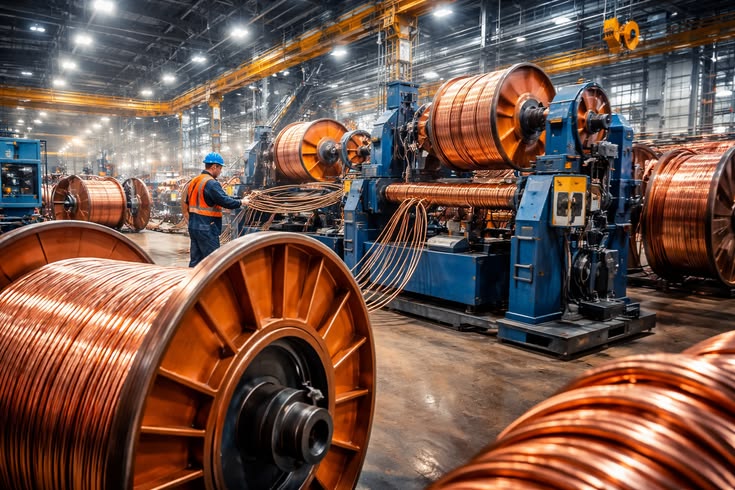
What Is the Difference Between Copper Wire and Enamelled Copper Wire?
The difference between copper wire and enamelled copper wire is the coating. Regular copper wire is either bare metal or wrapped in thick plastic, like the cable behind your TV. Enamelled copper wire wears a paper-thin layer of heat-resistant insulating varnish instead, so it can be wound into tight coils for motors, speakers, and transformers. Lighter, cheaper super enamelled aluminium wires use the exact same trick.
That's the short version. The rest of this guide explains the why in plain language, so it actually sticks.
The Difference at a Glance
|
Copper wire |
Enamelled copper wire |
|
|
Coating |
None (bare), or thick plastic like PVC |
Very thin layer of polymer varnish, a few microns thick |
|
Looks like |
Shiny orange-brown metal, or colorful plastic tubes |
Thin, shiny copper-colored thread, sometimes tinted brown, red, or green |
|
Main job |
Carrying electricity from point A to point B |
Making coils that create or react to magnetic fields |
|
Found in |
House wiring, extension cords, chargers |
Motors, transformers, speakers, electromagnets |
|
Soldering |
Easy |
The coating has to come off first. |
|
Other names |
Bare wire, insulated wire |
Magnet wire, winding wire |
First, What Is Copper Wire?
Copper is a metal that lets electricity flow through it very easily, which is why it's the default choice for wiring. When people say "copper wire," they usually mean one of two things:
- Bare copper wire: just the metal, with no coating at all.
- Insulated copper wire: copper covered in thick plastic (usually PVC). This is what runs through your walls and extension cords.
Insulation is simply a coating that stops electricity from jumping where it shouldn't. Thick plastic is great at that job. You can touch it safely and bend it around corners. But thick also means bulky, and bulk becomes a problem when you want to wrap a wire around something hundreds or thousands of times.
So What Is Enamelled Copper Wire?
Enamelled copper wire is regular copper wire with a very thin coating baked onto it. The coating is only a few microns thick, which is thinner than a human hair, so the wire still looks and feels like bare copper. (You'll also see it spelled "enamelled" in India and the UK. Same thing.)
Two fun facts. First, it has other names: magnet wire and winding wire. Second, the "enamel" isn't real enamel. It's a polymer varnish, nothing like the glassy coating on a cooking pot. The name just stuck around.
The coating does two jobs. It keeps neighboring loops of wire from touching and shorting out, and it survives heat. Depending on the type, coatings are rated for anywhere from about 130°C up to 250°C for the fanciest ones.
Why Is the Coating So Thin?
Here's the trick behind the whole thing. An electromagnet gets stronger the more loops of wire you can squeeze into a small space. Wrap a pencil with thread and you'll fit hundreds of turns. Wrap it with a garden hose and you'll fit about four. Thick plastic insulation is the garden hose. Enamel is the thread.
A thin layer is enough because the electricity in a coil only needs a small barrier between neighboring turns. Heat matters too. Inside a motor, a tight coil gets hot, much hotter than ordinary plastic insulation is built to handle. Enamel is made for exactly that.
More turns in less space means stronger magnets and smaller, more efficient motors. That's the whole reason enamelled wire exists.
How Enamelled Wire Is Made (The Short Version)
Copper is drawn through dies until it's as thin as needed, then heated (annealed) so it's soft and easy to wind. Next, the wire runs through baths of liquid enamel and then through a hot oven to bake the coat on. This repeats several times, building the coating layer by layer until it hits the right thickness. For a 1 mm wire, that finished layer is typically only a few hundredths of a millimeter.
Where You'll Find Each One
Regular copper wire is in your wall wiring, extension cords, appliance cords, and charger cables.
Enamelled copper wire hides inside electric motors (fans, washing machines, mixers), transformers, relays, generators, speaker and headphone coils, and that electromagnet you probably built in school with a nail and a battery.
Super enamelled aluminium wires do the same job in fans, transformers, and motors where weight and cost matter.
How to Tell Them Apart
Three quick checks:
- Look at the thickness. A chunky plastic sleeve means regular insulated wire. A thin, shiny thread means it's probably enamelled.
- Scratch it gently. Scrape a tiny spot with a blade or fine sandpaper (get an adult to help). Bare copper looks the same all over. Enamelled wire shows a brighter patch of bare metal where the film came off.
- Read the label. Spools are usually marked "magnet wire," "winding wire" or "enamelled."
Can You Solder Enamelled Wire?
Yes, but the coating gets in the way. Solder won't stick to varnish, so scrape or sand the tip until you see shiny metal. Some types burn off when touched with a hot soldering iron, but others don't, and burning enamel gives off fumes, so work somewhere well ventilated. If you've never used a soldering iron, ask an adult to supervise. Strip only the part you need to connect. The rest of the coating is doing important work.
Where Do Super Enamelled Aluminium Wires Fit In?
Everything above works for aluminium too. Swap the copper inside for aluminium and you get super enamelled aluminium wires: a metal core wearing the same ultra-thin insulating coat. They're widely sold as aluminium winding wires for transformers, fans, and motors. "Super enamelled" is simply the trade name suppliers use for these coated wires. What matters is the temperature class on the spec sheet, usually somewhere from 130°C to 200°C.
Why would anyone pick aluminium over copper?
- It's lighter. Aluminium weighs roughly a third as much as copper for the same volume.
- It's usually cheaper. That adds up fast on big orders.
- The trade-off: it conducts about 60% as well, so it needs roughly 1.6 times the cross-section of copper to match the resistance.
- Joining is different. You can't solder aluminium the way you solder copper, so connections are made with other methods, such as crimping.
So copper wins when space is tight. Aluminium winding wires win when weight and cost matter more, which is why they show up so often in large transformers and motors.
Common Mistakes to Avoid
- Using enamelled wire as house wiring. It isn't designed for mains-voltage wiring, and the thin coat scratches easily. Never swap it in for regular cable.
- Forgetting to strip the ends. If enamel still covers the copper where it should connect, your circuit won't work.
- Using bare copper wire for coils. The turns touch, the electricity takes a shortcut, and your coil does nothing.
Quick Recap
- Copper wire is bare or wrapped in thick plastic. Enamelled copper wire has a razor-thin varnish coat.
- The thin coat lets you fit more turns into less space, which is what coils need.
- You must strip the enamel before soldering or connecting.
- Aluminium winding wires are lighter and cheaper but need a thicker wire for the same current.
FAQ
Is enamelled copper wire insulated?
Yes. The enamel is the insulation. It's just far thinner than the plastic on ordinary cables.
Can enamelled copper wire carry electricity?
Yes. The copper inside does the carrying. The coating only stops electricity from jumping between neighboring turns, so you strip it at the ends to make a connection.
Is magnet wire the same as enamelled copper wire?
Basically, yes. "Magnet wire" and "winding wire" are the industry names for copper or aluminium wire with a thin enamel coating.
Why is aluminium wire used instead of copper?
It's lighter and usually cheaper, which helps in large transformers and motors. The trade-off is a thicker wire for the same current.
What are super enamelled aluminium wires used for?
Transformers, fans, motors, relays and other coils where cost and weight matter.
ID: 48
SLUG: difference-between-copper-wire-and-enamelled-copper-wire
RAW: NULL
CAST: NULL